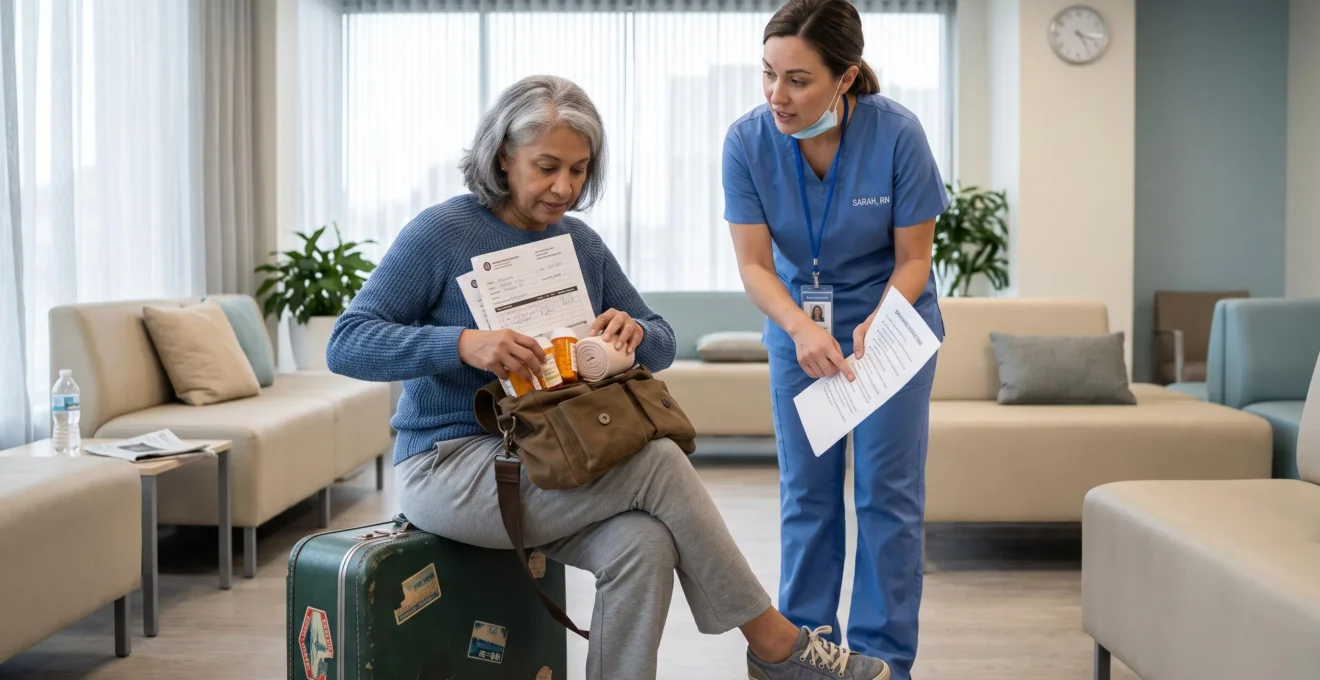
Returning home after orthopedic surgery performed in France or Andorra raises one practical question: how do you make sure the recovery stays as safe as if you had stayed near the operating team? The answer is prepared before you leave the clinic, not improvised once you are back. A structured follow-up relies on three pillars: a complete medical file in your hands, a planned schedule of remote check-ups with the surgical team, and a local healthcare provider identified before departure. This guide walks you through each step, from the discharge lounge to the end of your convalescence, and highlights the warning signs that always justify an in-person consultation close to home.
Post-operative follow-up after surgery abroad is organized before leaving the clinic: obtain a complete discharge summary, enough medication, emergency contacts and a planned schedule of teleconsultations. Once home, combine remote check-ups with the surgical team and physical examinations by a local healthcare provider, and seek in-person care immediately in case of fever, severe pain, calf pain or sudden shortness of breath.
What does post-operative follow-up involve after surgery abroad?
Post-operative follow-up is the structured medical monitoring that begins the moment surgery ends and continues until your surgeon considers recovery complete. For orthopedic procedures, it typically covers wound and dressing checks, pain and medication management, screening for complications (infection, thrombosis, mobility issues), and progressive rehabilitation. When surgery takes place abroad, this standard framework still applies, but it is split in two: a short in-person phase near the clinic, then a longer remote phase in your country of residence.
The core difference lies in physical access to the surgical team. On site, the surgeon can examine the wound, test the joint and adjust treatment within hours. Once you return home, the same information must flow through photos, video calls and reports shared with a local doctor. This is why coordination between the operating team and local healthcare providers becomes the backbone of a safe recovery after medical procedures abroad: each party needs the same documents, the same timeline and clear rules on who does what.
For most orthopedic surgeries, follow-up continues for several weeks to several months, with denser monitoring in the first six weeks. The exact rhythm depends on the procedure, your age, comorbidities and rehabilitation progress, and should be defined by your surgeon rather than estimated from general ranges.
What makes follow-up abroad specific
- Standard components remain: wound, pain, medication, complications, rehabilitation.
- In-person monitoring is shorter and concentrated around discharge.
- Remote monitoring requires written documents and a local relay.
- Duration is set by the surgeon, not by a generic timeline.
Planning your return home: key steps before leaving the clinic
Before boarding your flight home, the goal is simple: leave with everything you would need if a question or complication arose two days later, 1,500 kilometers away. The clinic team is used to these requests; make them explicit and written. In France, the discharge document that supports continuity of care is the lettre de liaison de sortie, a document legally required at hospital discharge and designed to inform the physician who will take over your follow-up. According to the French health insurance, this lettre de liaison obligatoire Assurance Maladie summarizes the reason for hospitalization, the medical synthesis, the medications and the planned care, which is exactly what your home doctor will need.
- Collect your medical fileDischarge summary, operative report, imaging on a USB key or secure link, prescriptions, implant card if a device was placed.
- Secure your medicationsEnough supply to cover the trip and the days required to see a local doctor, with generic international names (DCI) to ease substitution.
- Clarify wound care instructionsWritten protocol for dressing changes, showering, suture or staple removal date, signs that should trigger a call.
- Save emergency contactsDirect phone number or secure messaging for the surgical team, with time zone and preferred channel (call, email, platform).
- Book your follow-up calendarFix the dates of the first teleconsultations and, ideally, your first local appointment before you leave.
Do not leave without the discharge document: without a written medical summary, a doctor in your home country will have no reliable basis to adjust treatment, interpret imaging or react to a complication.
Plan the first local appointment within the first week after your return, even if everything feels fine. This visit anchors your recovery in the local healthcare system and gives your doctor time to read the file calmly before any urgent situation arises.
How to organize remote follow-up with your surgical team?
Remote follow-up usually combines scheduled teleconsultations with the surgical team and physical examinations performed by a local healthcare provider. Teleconsultation is now a well-framed medical act: the Haute Autorité de Santé recalls that it répond aux mêmes exigences que l’exercice médical en présentiel
, and that the physician decides whether it is appropriate for your clinical situation. You can review these recommandations HAS sur la téléconsultation to understand what the surgeon can and cannot assess through a screen.
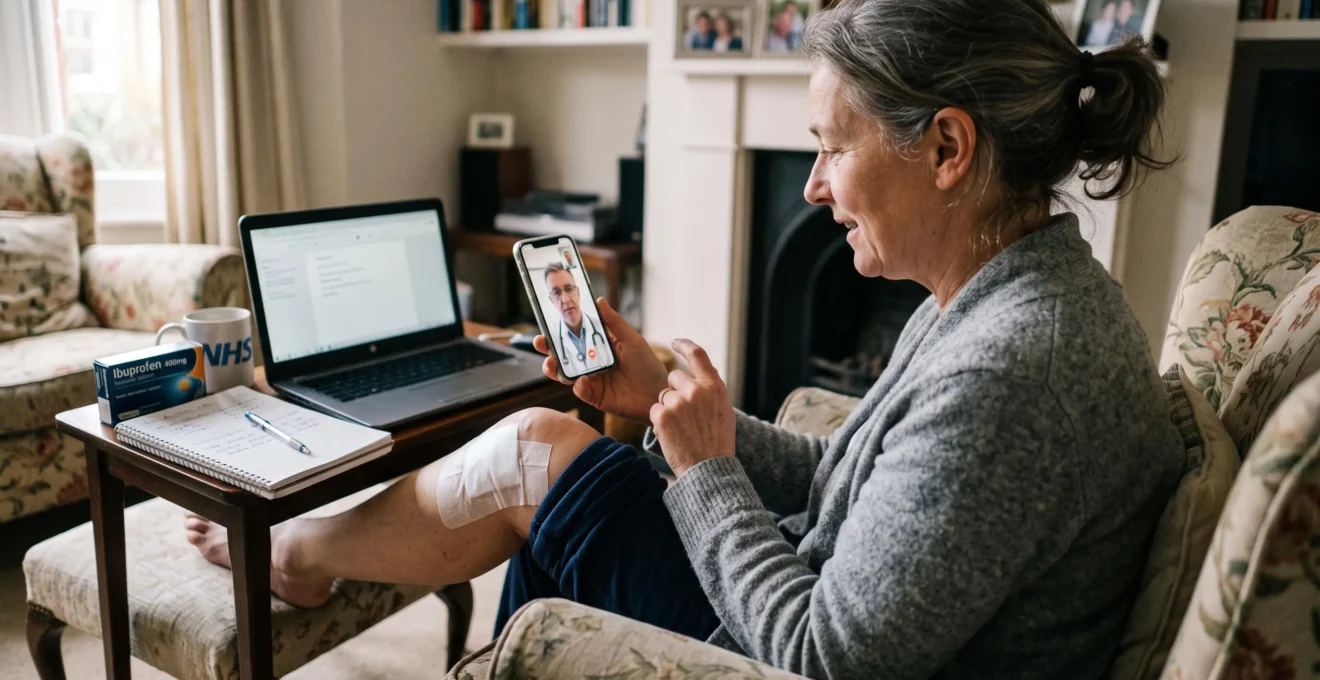
To make a teleconsultation genuinely useful, prepare it like an in-person visit. Take recent, well-lit photos of the wound from two angles, note your pain level, temperature, mobility progress and any new symptom, and have your medication list within reach. Keep a short written list of questions: forgetting them during the call is the main reason patients leave unsure. Teleconsultation is also increasingly common in France: a statistiques Drees téléconsultation France 2024 report indicates that 15 % des personnes de 18 ans ou plus déclarent avoir recouru au moins une fois à la téléconsultation
in 2024, which reflects a familiar practice for both doctors and patients.
Alongside remote check-ups, a local healthcare provider — typically your general practitioner, supported by a nurse for dressings and a physiotherapist for rehabilitation — performs the physical exams the surgeon cannot do from abroad. The key is document flow: share your discharge summary and operative report at the first visit, agree on how the surgeon will receive updates, and keep a single folder (digital or paper) where every report is centralized.
Example of coordinated follow-up
- Reviewing wound photos and healing progression.
- Adjusting pain medication or anticoagulant duration.
- Interpreting local blood tests or imaging.
- Guiding rehabilitation milestones with the physiotherapist.
- Answering questions quickly without a new trip.
- Physical examination of a suspicious wound or joint.
- Any suspected infection, thrombosis or implant issue.
- Severe or sudden symptoms (fever, chest pain, breathlessness).
- Falls, trauma or sudden loss of mobility.
- Situations the surgeon explicitly flagged as requiring a visit.
The HAS also reminds that teleconsultation may be considered inappropriate when a direct physical examination is essential or in case of medical emergency. In practice: a remote appointment is a monitoring tool, never a substitute for urgent care.
Warning signs that require in-person medical attention
Some symptoms should never wait for the next scheduled teleconsultation. If one of them appears, the rule is clear: go to a local doctor, an emergency department, or call your country’s emergency number, then inform the surgical team afterwards. Trying to reach the surgeon first can cost critical hours.
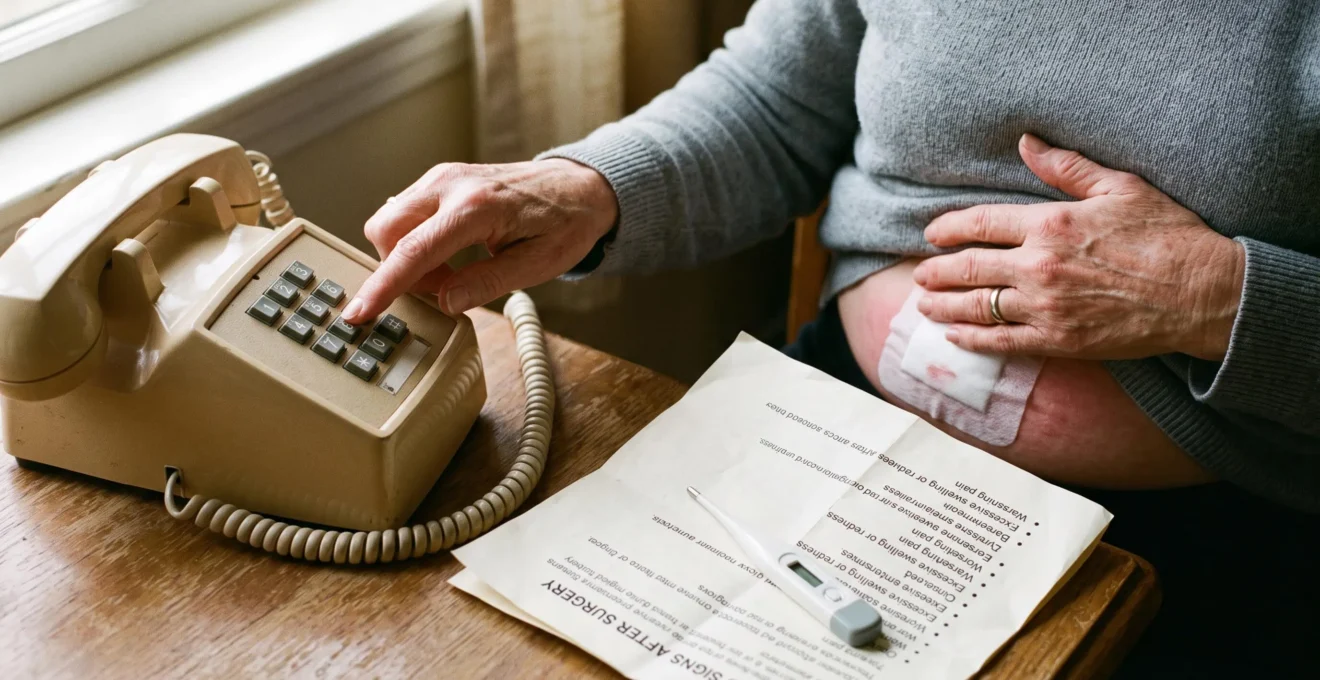
Warning signs most often reported after orthopedic surgery fall into three families: infection, thromboembolic complications and problems related to the operated area or the implant itself. The specific list applicable to your case must come from your surgeon, but the following categories are consistently flagged by health authorities.
- Signs of wound infection:Fever above 38 °C, increasing redness around the scar, warmth, pus or persistent discharge, foul smell. See a local doctor the same day.
- Signs of thromboembolic complication:Painful, swollen or hot calf, sudden shortness of breath, chest pain, coughing up blood. Call emergency services immediately.
- Issues related to the operated joint or implant:Sudden instability, abnormal cracking, severe or worsening pain, loss of function, new deformity. Seek in-person orthopedic evaluation.
- General alarming symptoms:High fever, confusion, fainting, uncontrolled bleeding. Go to the nearest emergency department.
Normal healing vs. infection: a simple comparison
In the first days, a scar can look slightly red, swollen and tender; this usually fades progressively. Infection, by contrast, tends to worsen over 24–48 hours and comes with systemic signs. The table below helps you distinguish a reassuring evolution from a concerning one, without replacing a medical opinion.
| Observation | Normal evolution | Concerning sign |
|---|---|---|
| Redness around the scar | Light, stable or decreasing after a few days | Spreading, intensifying, warm to the touch |
| Pain | Progressively decreasing with prescribed analgesics | Increasing day after day or sudden spike |
| Discharge | Minimal clear or slightly bloody fluid in early days | Pus, foul smell, persistent soaking of the dressing |
| Temperature | Normal or slight transient elevation | Fever above 38 °C, chills |
| General condition | Gradual improvement in energy and mobility | Fatigue, confusion, loss of appetite worsening |
Never wait for a scheduled teleconsultation if a warning sign appears: remote follow-up is designed for monitoring, not for emergencies. In doubt, consult locally first and inform the surgical team afterwards.
Making your recovery structured and secure
A safe recovery abroad relies on a simple architecture that you can describe in one sentence: a complete medical file in your hands, a planned calendar of teleconsultations with the surgical team, a local healthcare provider who has read your file, and a clear list of warning signs. If any of these four elements is missing, address it before anything else.
Respect the rehabilitation schedule even when progress feels slow. Skipping physiotherapy sessions or stopping anticoagulants earlier than planned are two of the most common causes of avoidable complications after orthopedic surgery abroad. Keep a simple logbook with your weight, temperature, pain level, medication intake and physiotherapy progress; it will make every teleconsultation faster and more precise.
Some structured international care services, such as International Elite Care, coordinate this remote follow-up as part of the overall pathway. Whether or not you use such a service, the underlying logic is the same: anticipate, document, and keep a local medical relay available.
How do I coordinate follow-up care between a surgeon abroad and a doctor in my home country?
Share your discharge summary, operative report and imaging with your local doctor at the first appointment after your return. Agree with the surgical team on who sends reports after each teleconsultation and how your local doctor receives them (secure email, patient platform). Keep one centralized folder with every document, in chronological order.
What are the limits of remote post-operative monitoring?
Teleconsultation cannot replace a physical examination when a complication is suspected, nor handle emergencies. It is well suited to visual wound checks, medication adjustments, interpretation of local tests and rehabilitation guidance, but any suspected infection, thrombosis or implant problem must be assessed in person.
Who should I contact in an emergency after surgery in France or Andorra?
Always use your country of residence’s emergency number first (for example 112 in the European Union). Then inform the surgical team through the dedicated contact given at discharge. The surgeon can share the operative details with the local emergency team if needed.
Can post-operative care really be handled from home?
Yes, provided it is organized before departure: full medical file, planned teleconsultations, identified local healthcare provider and a clear list of warning signs. Remote follow-up is reliable for monitoring; it is not designed to replace urgent in-person care when complications occur.
For related information on convalescence timelines after a specific procedure, you can also consult this detailed article on recovery time after a sphincterotomy, which illustrates how recovery markers are typically defined and monitored.
This article provides general information on post-operative follow-up after surgery abroad. It does not replace a personalized medical opinion. Always follow the specific instructions of your surgical team and consult a local healthcare professional in case of doubt or warning signs.